

Kalvi Kural 2025, Madhi Foundation’s annual symposium dedicated to reimagining and strengthening primary education in Tamil Nadu, was inaugurated by Dr. B. Chandra Mohan, IAS, Principal Secretary, School Education Department, Tamil Nadu, on June 27 at Residency Towers, T. Nagar, Chennai.
This year’s edition, spanning two days, is being hosted in collaboration with the Madras Institute of Development Studies (MIDS) and the Centre for Effective Governance of Indian States (CEGIS) as technical partners.
“Tamil Nadu has always believed that education is the one true power that can transcend societal barriers. When every child has access to quality education, it not only transforms their life but also the lives of generations to come. This belief has guided the State to ensure that schools are not just physically accessible—often within a kilometre—but also that education becomes the cornerstone of transformation for the child, the family, the State, and the world. Our flagship initiative, Ennum Ezhuthum (EE), is anchored in foundational literacy and numeracy (FLN), aiming to transform, remediate, and improve early learning outcomes. Through the large-scale SLAS assessment, we gained critical insights into classroom strengths and challenges, and the data clearly showed that EE is working,” said Dr. B. Chandra Mohan, IAS, Principal Secretary, School Education Department, Tamil Nadu.
He further added, “We’ve now launched THIRAN Iyakkam, a targeted effort for Classes 6 to 9 to improve learning outcomes. These insights are continuously feeding into our policy design, helping us keep a real-time pulse on the state of education.”
“We’ve also launched a large-scale career guidance programme to ensure that every Class 10 and 12 student can make informed choices based on their aptitude, preferences, and skills. With the highest Gross Enrollment Ratio in the country, Tamil Nadu is on the path to achieving milestones once thought unimaginable,” Dr. B. Chandra Mohan, IAS, said.
“Kalvi Kural is founded on a simple but powerful belief: that if we want meaningful, lasting change and reform, we must start by listening — listening not just to the familiar voices of policy, but to the lived experiences of every stakeholder — teachers, parents, children, administrators — whose realities and stories matter the most. When these voices are heard and honoured, real transformation becomes possible. Why do we focus on primary education at Madhi? Because that is where it all begins. For millions of children in India, primary school is not just the first experience of formal learning; it is sometimes the only one. The foundational years are when learning gaps emerge, but also when they can most powerfully be bridged. It is in these years that a child builds confidence, identity, and hope. If we fail them here, we risk failing them for life,” said Merlia Shaukath, CEO, Madhi Foundation.
“Primary education is the foundation, not just for the individual, but for the entire nation. As a country, while there has been considerable focus on primary education in recent years, we still have a long way to go. To make progress on this enormous challenge, it is important for the entire community—government officials, academia, parents, non-profit organisations, and the private sector—to come together and work as one team with a shared vision to improve primary education. Kalvi Kural provides a platform for these diverse voices to come together, share ideas, network, and form partnerships. I’m sure this will go a long way in improving primary education, and CEGIS is glad to play a part in supporting this event,” said Ramnath Sankaran, Lead – Education Sector, CEGIS.
Kalvi Kural is a two-day event featuring over 35 speakers from across the country. The symposium includes parallel sessions, panel discussions, masterclasses, and case panels.
Featured Speakers Include:
• Padma Shri Dr. Shantha Sinha, Child Rights Activist & Founder, Mamidipudi Venkatarangaiya Foundation (MVF)
• Suhel Bidani, Digital & AI Lead, Bill & Melinda Gates Foundation
• Mercy Ramya I.S., IAS, Director, ICDS
• Milind Brahme, Professor, IIT Madras
• Vishal Sunil, Co-Founder & CTO, Rocket Learning
• Prema Rangachary, Director, Vidya Vanam
• Ankit Goel, Vice President, Samagra
• Damini Mainkar, COO, Leadership for Equity
• Divya Jayaraman, Project Lead, Reform Initiatives – School Education and Rural Societies
• Gautam Prakash, Senior Product Manager, Glific
• Gauthamraj Elango, Head of Technology, Reap Benefit Foundation
• Kavita Rajagopalan, Director, Global Schools Forum
• Krishnan Narayanaswamy, Program Manager, Michael & Susan Dell Foundation
• Mainak Roy, Co-Founder & Director, Simple Education Foundation
• P.A. Naresh, Director, Elementary Education
• Parthajeet Das, Director, Central Square Foundation
• Poornima Arun, Founder, Marudam Farm School
• Prahalathan KK, Co-Founder, Bhumi
• Ramnath Sankaran, Lead – Education Sector, CEGIS
• Regila Marinus, Co-Founder & CEO, Vidhya Vidhai
• Samyukta Subramanian, Lead – ECE and Early Grades Program, Pratham Education Foundation
• Saransh Vaswani, Co-Founder, Saajha
• Sashwati Banerjee, Founder, Top Parent
• Sunitha Ravichandran, COO, Yein Udaan
• Vedika Agarwal, Founder, Yein Udaan
• Vighneswaran B., Program Lead – Organisation Development, The Education Alliance
🔗 For the full speaker list and schedule, visit:
https://events.madhifoundation.org/2025#/speakers
Inaugural Plenary:
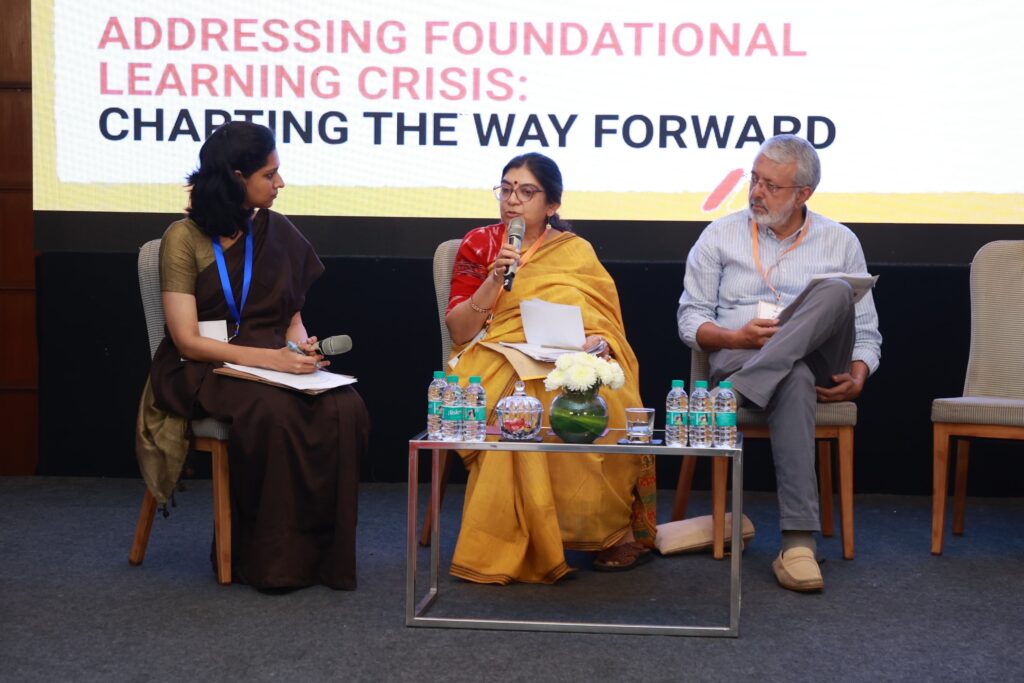
The inaugural plenary, “Addressing the Foundational Learning Crisis: Charting the Way Forward,” featured Prof. Rekha Sharma Sen, Professor of Child Development, IGNOU Mr. Ranganath N. Krishna, Former MD & CEO, Grundfos Pumps India Pvt. Ltd. And was moderated by Vijayalakshmi Mohan, COO, Madhi Foundation.
Speakers emphasised that while assessments provide useful data, real change requires sustained, empathetic teacher support, classroom-level insights, and mentorship beyond one-time training. Accountability should guide, not penalise. Ranganath urged a shift from rote learning to curiosity-driven ecosystems and questioned societal definitions of success. Both panellists highlighted the importance of bottom-up change, collaborative action, and redefining impact. Public-private partnerships, if done meaningfully, can help scale innovations and build a more inclusive, learner-focused education system.
Special Segment:
A Children’s Panel moderated by Prabhakaran Karunamoorthi, City Director, Teach For India – Chennai, exploring students’ perspectives on education.
About Author

More Stories
Advanced GroHair & GloSkin Clinic Expands Beyond 150+ Clinics with the Grand Launch in Thirumazhisai.
Beyond Brunches & Bouquets: Real Ways to Celebrate Sisterhood This Women’s Day
Checkmate 2026 Delivers a Grand Opening: Rotary Club of Chennai Carnatic & GSquare Back Youth Champions