

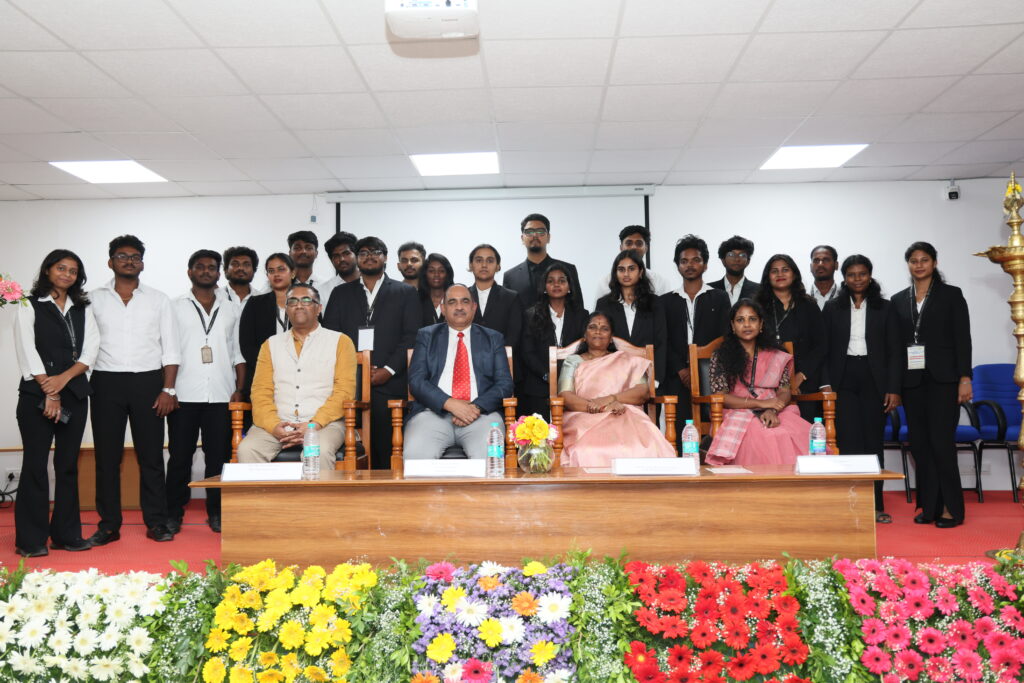
Chennai, October 2026: In a significant statement on gender equality and the future of the legal profession, SRM School of Law, SRM Institute of Science and Technology (SRMIST), Kattankulathur, successfully hosted the 8th National Level Tamil Moot Court Competition 2026, bringing together 42 teams and 126 participants from law institutions across India. A defining highlight of the competition was an all-women panel of five distinguished legal professionals adjudicating the final round, underscoring the importance of women’s leadership, representation and equal opportunity in the legal profession.
Government Law College, Dharmapuri, emerged as the winner, while Mother Teresa Law College secured the runner-up position. The Best Memorial and Best Researcher awards went to participants from Government Law College, Karaikudi, while the Best Speaker award was presented to a participant from Government Law College, Tirunelveli.
The competition marked a significant milestone in its eight-year journey by bringing together excellence in legal advocacy, the promotion of Tamil as a language of courtroom discourse, and a commitment to gender equality in line with United Nations Sustainable Development Goal 5 (SDG 5).
The final round was adjudicated by an eminent women-led panel comprising Hon’ble Justice (Retd.) Prabha Sridevan, former Judge of the Madras High Court; Professor Dr. N. Kayalvizhi, Principal, Dr. Ambedkar Government Law College, Pattaraiperumbudur; Professor Dr. Jaya Gowri, Principal, Dr. Ambedkar Government Law College, Pudupakkam; Senior Advocate Geetha of the Madras High Court; and Senior Advocate G. V. Shobha of the Madras High Court.
The panel highlighted the significance of women’s representation and leadership in the legal profession, reinforcing the role educational institutions can play in advancing gender equality and nurturing a more inclusive legal community.
The competition was conducted across three stages, testing participants’ legal knowledge, analytical reasoning, advocacy and courtroom skills. During the preliminary rounds, 42 judges evaluated teams on their interpretation and application of law, use of legal authorities, quality of legal reasoning and ability to respond to questions from the Bench. Eight teams advanced to the quarterfinals, where they competed in a knockout format that tested their precision, persuasive argumentation, courtroom etiquette and ability to defend their legal positions under scrutiny.
The event also celebrated Tamil as a language of legal advocacy, providing students from law institutions across India with a platform to develop their courtroom confidence and demonstrate their ability to articulate complex legal arguments. By promoting linguistic inclusivity, the competition highlighted the importance of making legal education more accessible while bridging the gap between classroom learning and the practical demands of legal practice.
Addressing the participants, Hon’ble Justice Bhavani Subbarayan (Retd.) emphasised the importance of strengthening research, drafting, pleading and analytical skills. She highlighted the value of practical exposure and the need for an unwavering commitment to justice.
Hon’ble Justice N. Mala of the Madras High Court encouraged students to embrace both success and failure as integral parts of their professional journeys, describing failure as a stepping stone to success. Drawing on her experience as a first-generation lawyer, she spoke about overcoming self-doubt, persevering through challenges and building professional confidence through experience. She urged students to uphold integrity, embrace continuous learning and build their careers on a strong ethical foundation.
The 8th National Level Tamil Moot Court Competition 2026 reaffirmed SRM School of Law’s commitment to experiential legal education, professional excellence, linguistic inclusivity and gender equality. By bringing together aspiring advocates, judicial experts, senior members of the Bar and academic leaders, the competition created a meaningful platform for professional exchange, practical legal learning and the development of future-ready legal professionals.
By bringing women’s leadership into focus and placing Tamil at the centre of courtroom advocacy, SRM School of Law demonstrated how legal education can advance both professional excellence and a more inclusive legal profession.
About Author


More Stories
SRM Medical College Hospital & Research Centre Inaugurates National Geriatric Summit “AGE WELL INDIA”
SRM Ramapuram Makes a World Record Attempt to Promote Sustainable Fashion and Textile Upcycling
THE QUAIDE MILLETH COLLEGE FOR MEN 43RD GRADUATION CEREMONY REPORT